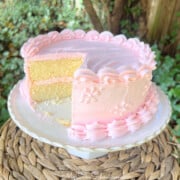
White Almond Sour Cream Cake
This super moist and delicious scratch White Almond Sour Cream Cake is rich with a velvety soft texture. Perfect when paired fruity frostings, chocolate frostings, vanilla buttercream, and more.
Servings: 15
Ingredients
- 3 Large eggs, room temperature (If in a hurry, place in a bowl of warm water for 5 minutes.)
- 2 tsp. vanilla extract (8g)
- 1 tsp. almond extract (4g)
- ⅓ c milk (73g)
- 1 cup sour cream (242g)
- 2 tablespoons Vegetable Oil (we used canola oil) *This is an updated addition (see notes)
- 2 ½ c cake flour (285g)
- 1 ½ c granulated sugar (300g)
- 2 ½ teaspoons baking powder (12g)
- ½ teaspoon salt (3g)
- 1 ½ sticks unsalted butter (170g or ¾ cup) It should be softened (not microwaved) and should easily "dent" when pressed but shouldn't be overly soft or glossy.
Vanilla Buttercream Frosting
- 2 ½ sticks unsalted butter, room temperature (282g or 1 ¼ cup)
- 6 cups 690 grams powdered sugar. *** You can adjust the sugar amount up or down based on your consistency preferences.
- 2 tsp. vanilla extract (8g)
- ¼-1/3 cup (72g) milk or cream, more if needed
- ½ teaspoon salt (3g)
Instructions
- Preheat oven to 350 degrees Grease and flour two 8 x 2 inch pans.
- Place you butter on the counterop to come closer to room temperature. It is ready when it holds its shape but dents easily when pressed. It shouldn't be overly soft and glossy.
- "Egg Mixture" - In a small bowl, combine eggs, vanilla extract, almond extract, milk, sour cream, and vegetable oil. Set to the side.
- Add the dry ingredients (cake flour, granulated sugar, baking powder, and salt) to a mixing bowl and mix with the electric mixer for 30 seconds or until well combined.
- Add the softened butter to the dry mixture in thick slices, while mixing at medium speed. Mix for approximately 40-60 seconds or until the dry ingredients take on a "sandy" consistency. Make sure to stop at this "sandy" stage. (Don't over-mix, or the consistency turns into a dough-like paste.)
- With an electric mixer set to low speed, slowly add *half* of the egg mixture, and then increase to medium speed for 1½ minutes. The batter will be thick and fluffy. Scrape bottom and sides of bowl.
- Next, add half of the remaining egg mixture, mix for 20 seconds, then add the remaining egg mixture, and mix for 20 seconds more.
- Bake at 350 degrees for 35 minutes. Bake times may vary and so peek in as you approach the 30-35 minute mark and adjust time if needed. An inserted toothpick should come out clean or with just a few moist crumbs attached.
- Allow the cake layers to cool (still in the pan) for 10 minutes before turning out. **These layers pull away from the cake pans more than most of our recipes but once turned out, they will look perfect.)
- Cool the layers completely before frosting.
Vanilla Buttercream Frosting
- Cream the room temperature butter until smooth. Blend in the vanilla.
- Add half of the powdered sugar and most of the milk. Mix at medium speed until the powdered sugar is incorporated.
- Add remaining powdered sugar and milk and mix at medium speed another 3 to 4 minutes scraping the sides of the bowl occasionally. I then slow down the mixer to very slow. (#2 on the Kitchenaid) for 1 to 2 minutes at the end. This will help eliminate air pockets in the buttercream. (*For the cake in the photo, we added a touch of Americolor Deep Pink to our frosting.)
- Yields approximately 4 ½ cups of frosting.
- If your buttercream is too thin, add more confectioners sugar. If the consistency is too thick, add a bit more milk.
Decorating the Cake
- Place the first cooled cake layer on the cake base or pedestal and spread with a layer of frosting. Top with the second cake layer. Then, apply a thin coating of frosting on top and around the sides of the cake. At this point we like to move the cake to the freezer for 15 minutes (or refrigerator for longer) to firm everything up a bit before adding the final layer of frosting. This helps to seal in the crumbs and prevents your cake from shifting around as you decorate.
- Decorate however you like (we used a 1M tip for our borders and a 4 tip for the little daisies).
Storage
- The cake is fine in a cake dome or in an airtight container for 1-2 days (assuming your room isn't very warm). Buttercream can melt if too hot, just as butter does. Beyond that, move to the refrigerator for freshness. Cakes firm up when chilled because they contain butter. For this reason, remove cake from refrigerator 2-3 hours before serving for the softest texture.
Notes
This recipe is originally from a 2014 post. We updated it in 11/2026 to add 2 tablespoons of vegetable oil, updated photos, etc.. If you love this recipe just as it was before, it is fine to leave out the oil. We just liked that added boost of moisture. (We also experimented with ¼ cup but that was too much). ;0) We love this version. Enjoy!
Freezing: These layers can be baked in advance and wrapped in plastic wrap followed by foil and frozen for up to three months!
Thawing: Thaw, wrapped on counter for at least 15 minutes before unwrapping (so that condensation will form on the wrapping rather than the cake.) - Some decorators prefer to frost their cakes while they are still partially frozen as they are less fragile.